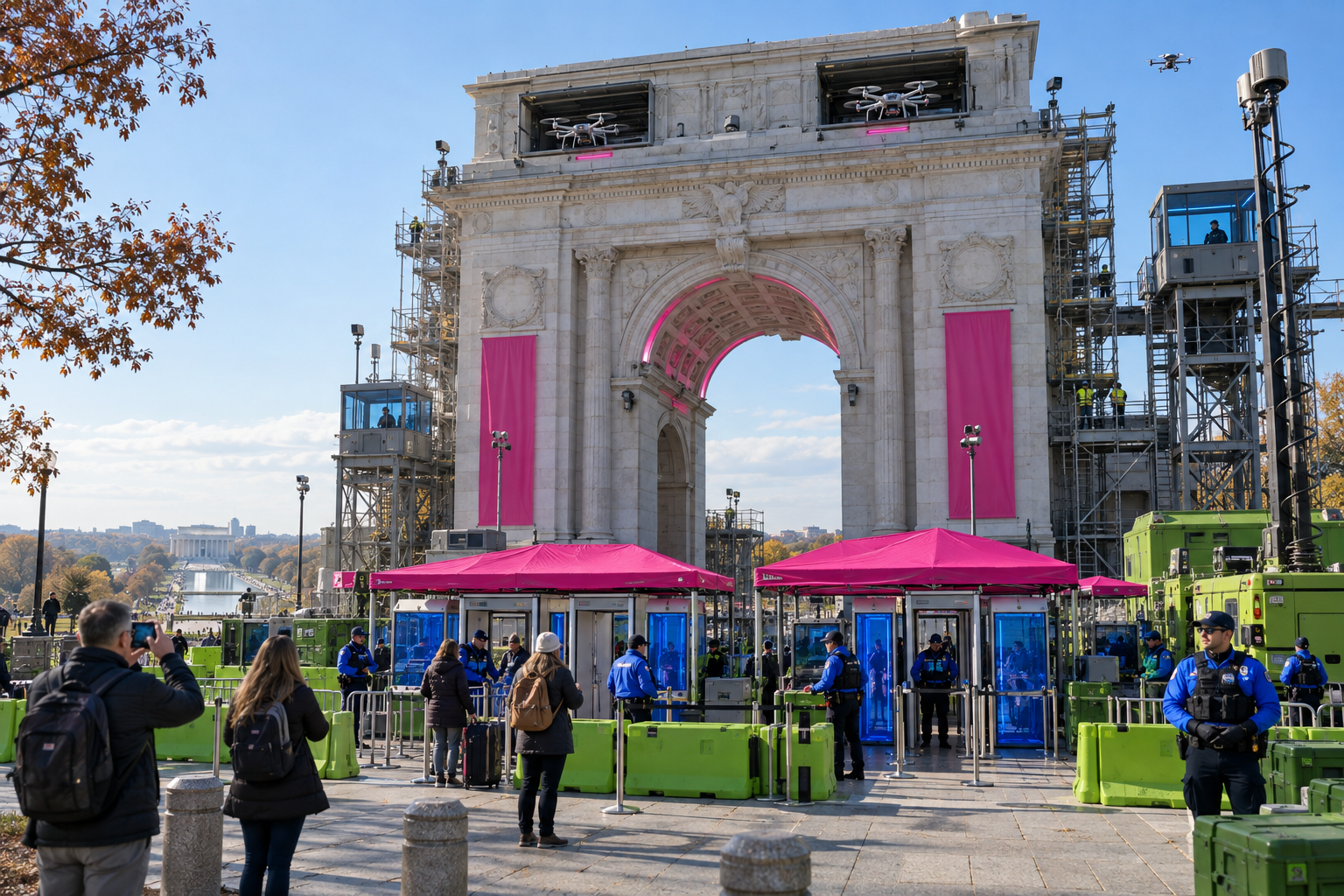
WASHINGTON—President Donald Trump has announced that his proposed triumphal arch near Arlington National Cemetery will double as a “top grade Military Complex,” completing the capital’s transition from a city of symbolic monuments into an extremely ornate place to remove your belt and empty your pockets.
In a real Truth Social post on September 20, Trump said the structure would house and rapidly deploy large numbers of drones, position snipers on the roof and plaza, and store substantial quantities of sniper ammunition. He said the conversion came at the strong request of the United States military and for national-security purposes.
The Pentagon had not publicly confirmed that request when major news organizations reported the announcement. This left the country with a familiar federal planning problem: the commander in chief says the military wants a weaponized arch, the military says nothing, and the architect quietly adds “drone hatch” to a drawing that previously featured eagles.
Beaux-Arts meets airport security
The proposed structure would rise 250 feet at Memorial Circle, on the western end of Arlington Memorial Bridge between the Lincoln Memorial and Arlington National Cemetery. Federal planning documents describe a stone arch, plaza, observation areas, traffic changes and visitor screening with magnetometers, X-ray machines and explosive-trace detection.
The new military concept adds a fresh design vocabulary best described as “Paris, but the gift shop has overwatch.” Visitors will reportedly experience the grandeur of classical architecture, the efficiency of airport security and the soothing knowledge that several unmanned aircraft may be charging directly above the allegorical sculpture.
Pink Slime has learned from absolutely no one that the fictional visitor program will include timed-entry tickets, a panoramic observation deck and a concierge trained to answer the question, “Is that drone ceremonial?” with the legally approved phrase, “Please continue moving.”
A fictional brochure describes the complex as the nation’s first mixed-use monument: part arch, part weapons depot and part reminder that every public project eventually acquires a secure loading zone. The brochure recommends comfortable shoes, government-issued identification and not pointing enthusiastically at the rooftop.
The planning process puts on a helmet
The National Capital Planning Commission gave preliminary approval to the site and building plans on July 9, while requesting additional justification for the height, transportation effects, airport safety lighting, materials and management. The Commission of Fine Arts approved the architectural design in May, while asking for later review of the sculpture and decorative program.
Those reviews examined a monumental gateway with security screening and controlled access—not the fully militarized version announced this weekend. America therefore faces the rare administrative challenge of determining whether a sniper plaza counts as a minor design revision or requires somebody to reopen the spreadsheet.
The National Park Service’s environmental and historic-preservation reviews also document concerns about effects on the ceremonial landscape linking the Lincoln Memorial, Arlington Memorial Bridge and Arlington National Cemetery. More than 100,000 public comments were submitted during the review process, according to NPR.
A federal judge has ordered the government to provide 48 hours’ notice before beginning work at Memorial Circle while litigation proceeds. Plaintiffs, including Vietnam veterans and an architectural historian, argue that the project would harm the setting and lacks required congressional authorization. Those are unresolved legal claims, not conclusions.
The fictional Department of Monument Escalation responded by unveiling a permitting flowchart in which each objection travels upward through a series of increasingly defensive architectural features. Height concern? Add radar. Traffic concern? Add barricades. Historic-view concern? Provide visitors with a complimentary pair of binoculars pointed somewhere else.
A monument finally ready to defend itself
Triumphal arches traditionally commemorate military victories after the fighting is over. This one appears determined to keep its options open. The structure can celebrate past glory, monitor current airspace and potentially launch something before the tour group reaches the mezzanine restroom.
Supporters can praise a grand new national landmark. Critics can question its legality, scale and impact. Security planners can request another equipment room. And tourists can stand beneath 250 feet of stone wondering why a monument to confidence requires this many locked doors.
In the meantime, Washington’s older memorials remain defenseless. The Jefferson Memorial has no drone bay. The Washington Monument stores no ammunition. The Lincoln Memorial continues relying on 19 feet of seated disappointment.