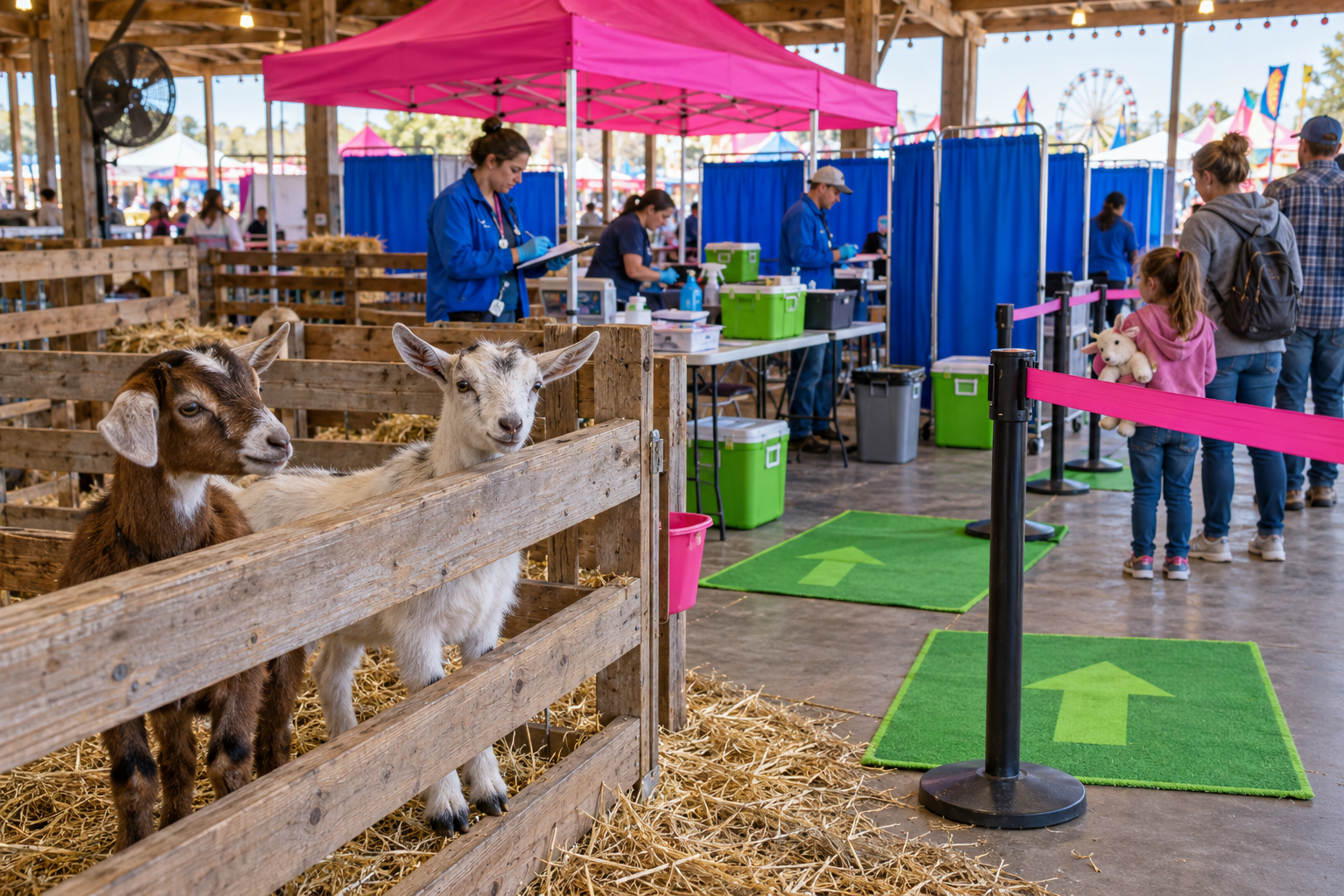
AMERICA—The Centers for Disease Control and Prevention has issued a national advisory about increased reports of human exposure to rabid or potentially rabid animals, forcing the nation to confront a medical question it never expected to ask before lunch: exactly how much baby-goat contact was included in the admission price?
The real CDC advisory, distributed September 10, says multiple jurisdictions have reported local increases in human rabies exposures since July, including unusual animals and mass-exposure events. From July through August, the agency received 17 percent more rabies-related inquiries than during the same period in 2025. At least eight state health departments also reported increased use of post-exposure treatment, errors in administering it, or both.
That is a serious public-health matter. It is also the moment every wholesome attraction discovers that its liability waiver needs a new paragraph between “hay may enter footwear” and “the alpaca has personal boundaries.”
Please initial beside the mammal
In North Carolina, state health officials confirmed rabies in three baby goats from a mobile petting zoo on August 28 and presumed a fourth was infected. The goats were believed to have encountered a skunk that entered their pen. Officials advised anyone who touched the animals between July 28 and August 27—at the main location or off-site events—to contact a local health department for an exposure assessment.
The events included children and older adults, two groups traditionally drawn to baby goats because baby goats have spent centuries cultivating the brand position “surely nothing this adorable has paperwork.” North Carolina reported no human rabies cases from the incident, and the state has not recorded a human case since 2011.
Petting-zoo consultants immediately unveiled a fictional three-tier experience. General Admission permits looking at a goat from a respectful distance. Premium Admission includes one supervised forehead pat and a travel-size bottle of soap. The Platinum Hoof package provides unlimited selfies, a laminated exposure-flowchart and an attorney dressed as a scarecrow.
“The goat remains complimentary,” explained an entirely invented risk manager. “The goat-adjacent administrative ecosystem is now $39.95 plus processing.”
Beaver division requests privacy
Maryland also recorded rare rabid-beaver incidents this summer. State officials reopened all areas of Seneca Creek State Park on September 16 after monitoring found no additional rabid beavers near the site of an August attack. Authorities stressed that wildlife should be observed from a distance and that rabies and other risks remain present anywhere people encounter wild animals.
The nation responded by pretending it had always understood “wildlife” to mean “life that should not be hugged for content.” A blue-ribbon panel of fictional lifestyle influencers recommended approaching every woodland creature slowly, filming vertically and asking whether it has accepted the collaboration invite.
Beavers, meanwhile, issued no statement because they were busy maintaining infrastructure without a federal grant.
The least fun follow-up appointment
The CDC estimates that roughly 1.4 million people in the United States seek medical care after animal contact each year and about 100,000 receive rabies post-exposure prophylaxis. Pharmacy data through September 2 showed rabies-vaccine use up 33 percent and human rabies immune-globulin use up 76 percent compared with 2025, according to the advisory.
Rabies is almost always fatal after symptoms begin, but prompt, correctly administered preventive treatment is highly effective. Officials advise people who may have been bitten, scratched or exposed to saliva from a potentially rabid animal to wash the area thoroughly with soap and running water for 15 minutes and contact a health-care provider or public-health department promptly.
This is not the moment for homemade diagnosis, an online quiz titled “Which Furious Woodland Mammal Are You?” or waiting to see whether the raccoon sends a follow-up email. Risk assessment belongs with medical and public-health professionals familiar with local rabies patterns.
County fairs are expected to adapt quickly. New attractions under consideration include the Hand-Sanitizer Hayride, the Epidemiology Ferris Wheel and a game where visitors toss rings onto increasingly specific insurance exclusions.
The baby goats will continue doing what baby goats do: standing on buckets, yelling at breakfast and looking innocent enough to defeat several centuries of human judgment. Guests may still admire them. They are merely advised to remember that “adorable” is a visual category, not a laboratory result.