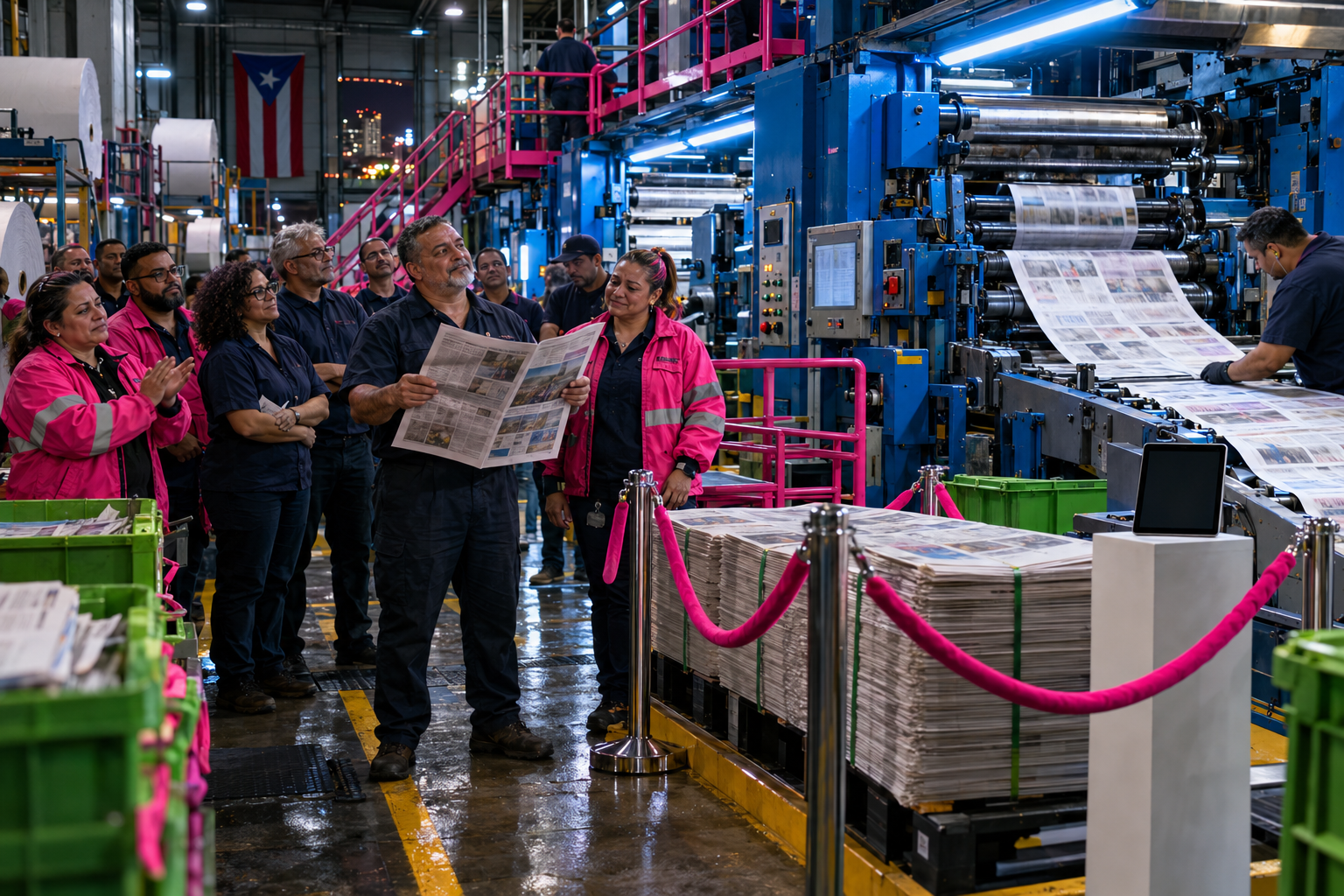
SAN JUAN—Two of Puerto Rico’s largest newspapers officially became digital-only Monday, a historic transition expected to save paper, preserve journalism and force generations of breakfast-table readers to learn how to shake cracker crumbs out of a tablet.
GFR Media ended the print editions of Primera Hora and El Nuevo Día after final issues on September 24 and September 27. The company said the move responds to changing audience habits and will allow the publications to meet Puerto Ricans wherever they are, provided wherever they are has accepted the cookie settings.
El Nuevo Día, founded in 1970, closed its press era with edition number 20,411 after 56 years documenting elections, hurricanes, debt crises, protests, papal visits and the steady decline of anyone’s ability to read an article without a video beginning automatically. Its final printed front page declared that paper ends while journalism continues—a sentence both dignified and suspiciously easy to fit on a tote bag.
Please turn your screen to page B4
Under Pink Slime’s entirely fictional reader-transition program, subscribers will receive a ceremonial PDF every morning with instructions to fold their laptop into quarters, place it beneath a cup of coffee and shout at the opinion section. Technical support strongly advises against this, especially the folding.
Veteran readers may request a “paper experience” accessibility package consisting of a newsprint-scented screen wipe, one rubber band and a neighbor’s arm appearing over the fence to ask whether the sports section is finished. Sunday subscribers will receive a 600-megabyte attachment that lands on the kitchen table with a spiritually equivalent thud.
The real digital audience is already substantial. GFR Media says El Nuevo Día reaches more than 3.4 million unique users per month and Primera Hora more than 2.8 million. El Nuevo Día launched online in 1997, meaning its website is old enough to remember when “going viral” still warranted antibiotics.
The company has expanded video podcasts and plans a weekly news-analysis program. That is sensible: the modern audience prefers important civic information delivered in the same rectangular format used by dance challenges, skin-care demonstrations and men explaining compound interest from inside rented sports cars.
The press stops; the push alert stretches
Losing a print edition is not the same as losing a newsroom, but the distinction matters most when the newsroom remains strong enough to report on the institutions around it. The Associated Press noted that it was not immediately clear whether the transition would cause layoffs. It also cited the Association of Puerto Rican Journalists, which said Grupo Ferré Rangel’s unionized workforce had fallen from nearly 400 employees in 2015 to fewer than 100 in 2025.
That trend is bigger than two papers. Thousands of U.S. newspapers have closed in the past two decades while advertising revenue, subscriptions and newsroom jobs migrated into the misty realm known as “the platform economy,” where a local investigation competes for attention against a raccoon opening a cooler.
Print had obvious costs: ink, paper, presses, trucks and the daily logistical miracle of getting a physical object to thousands of doors before its lead story became history. Digital eliminates much of that machinery. It replaces it with servers, apps, subscriptions, analytics dashboards and the serene certainty that a social-media company can redesign its algorithm during lunch.
Readers also lose small rituals that never appeared on a balance sheet. A printed front page could be saved after a hurricane, passed across a counter, carried onto a bus or discovered decades later in a drawer. A homepage can do all of those things only if somebody remembers the password, renews the domain and does not decide that seventeen years of public memory is cluttering the content-management system.
Tomorrow’s archive needs a charger
Pink Slime’s imaginary Department of Cultural Continuity has proposed a national reserve of emergency newspapers. Each municipality would receive one broadsheet sealed behind glass with a small hammer and a sign reading: “In case the cloud is down, break and read yesterday.”
It would also train young people in lost print skills, including refolding the paper after someone else has destroyed it, locating a continuation on page A17 and understanding why an adult once clipped an article with scissors instead of sending a link that expires behind a login wall.
None of this means the journalism is over. The reporters remain, the brands remain and Monday’s news is still arriving. It simply arrives without ink on the fingers, a plastic sleeve in the rain or the faint possibility that the comics page is hiding somewhere inside Business.
Puerto Rico has turned the page. The page is now a screen, it wants permission to send notifications, and it has detected that your ad blocker may be preventing democracy from loading correctly.