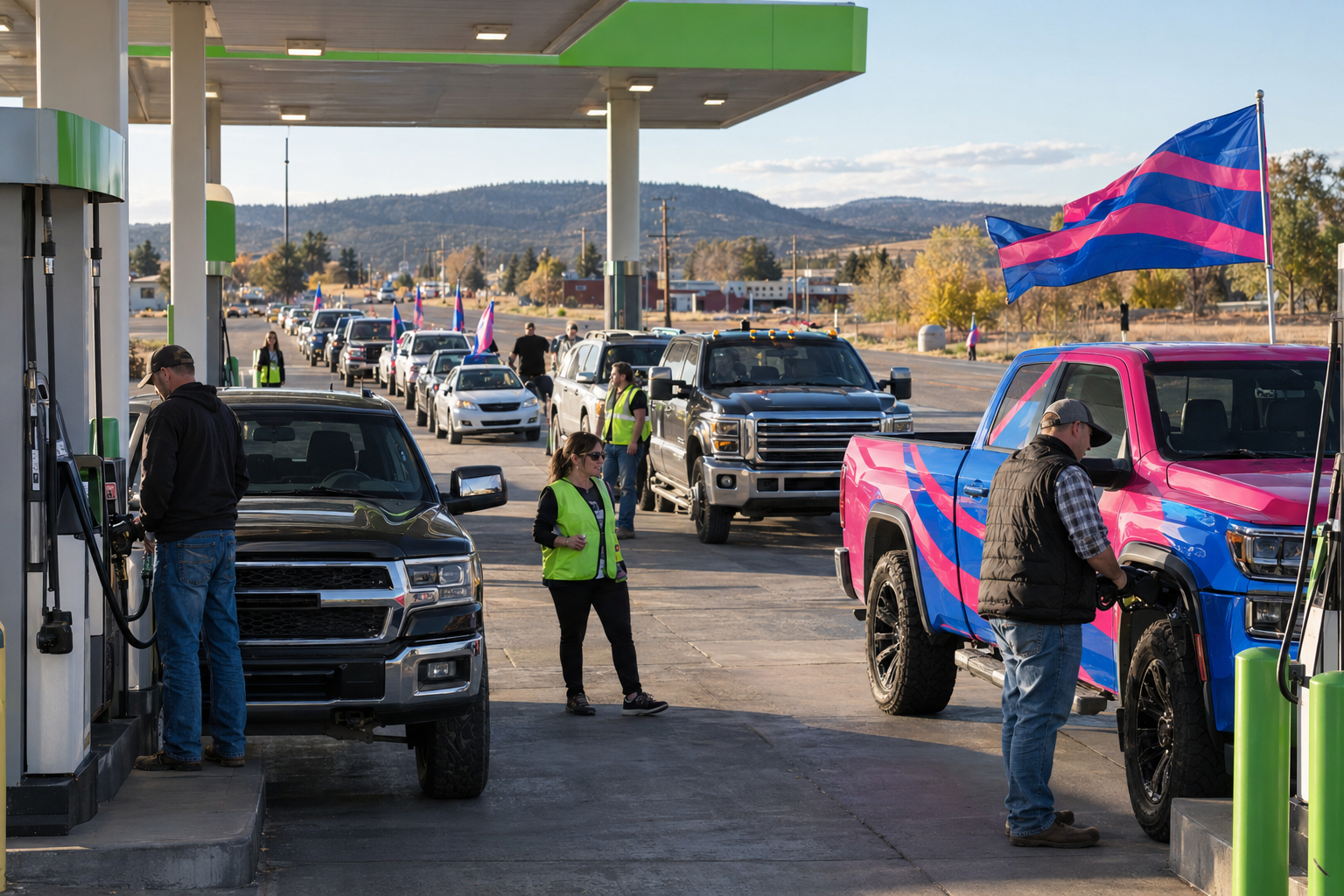
THE FUEL PUMP—Political vehicle convoys turn support into spectacle by putting flags on cars, trucks and motorcycles and then putting all of them on the road at once. That formula has not changed. The price of running it has.
The U.S. Energy Information Administration reported on September 15 that the national average price of regular gasoline was $4.319 a gallon for the week ending September 14. That was 16.2 cents higher than one week earlier and $1.151 higher than a year earlier. On-highway diesel averaged $6.285 a gallon, up 31.8 cents for the week and $2.546 from a year earlier. The averages include taxes.
In percentage terms, regular gasoline rose about 3.9% in one week and 36.3% from the same week last year. Diesel climbed about 5.3% in one week and 68.1% year over year. Those increases apply equally to a work commute, a family road trip and a line of flag-covered pickups demonstrating political support. The pump does not offer a First Amendment discount.
What the convoy math actually says
There is no standard size, route or vehicle mix for a political convoy. “Trump Train” is commonly used for vehicle rallies organized by supporters of President Donald Trump, but individual events vary. The Associated Press described dozens of cars and trucks in the October 2020 Texas convoy that surrounded a Biden-Harris campaign bus. Other rallies have included cars, pickups, motorcycles and semi-trucks.
Because there is no universal convoy, the following is an illustration, not a reported event budget: assume 50 vehicles travel 100 miles each and average 15 miles per gallon. The group would collectively burn about 333 gallons.
| Illustrative fuel | Sept. 14, 2026 | Year-earlier price | Added cost |
|---|---|---|---|
| Regular gasoline | $1,440 | $1,056 | $384 |
| On-highway diesel | $2,095 | $1,246 | $849 |
The table does not say that every vehicle uses the same fuel or achieves 15 mpg. It isolates the effect of the EIA price change while holding distance and fuel economy constant. A smaller, more efficient car would use less. A heavy truck, long idle time, stop-and-go traffic or extra distance to reach the starting point would use more.
A mixed example shows how quickly small individual bills aggregate. If 35 gasoline vehicles and 15 diesel vehicles each drove that same 100-mile route at 15 mpg, the fuel bill would be about $1,636 at the September 14 averages. At the implied year-earlier prices—$3.168 for regular and $3.739 for diesel—the same exercise would cost about $1,113. The difference is roughly $523.
Triple the field to 150 vehicles under the same assumptions and the added year-over-year cost triples too, to about $1,570. Arithmetic is rarely invited to the rally, but it follows every vehicle anyway.
Who pays is a separate question
A collective estimate is not the same as an organizer's invoice. Participants may buy their own fuel, share rides, drive only part of a route or travel different distances to and from an event. An organizer might pay for separate staging, security, signage or commercial vehicles, but those expenses cannot be inferred from the pump price alone.
Nor do higher prices prove that convoys are becoming less frequent, that supporters are angry or that attendance will change. Reliable participation data would be needed to make any of those claims. The narrower conclusion is mechanical: when a gallon costs more, an otherwise identical vehicle event costs more to operate, and diesel-heavy convoys feel a larger increase under the latest national averages.
The nonpartisan meter keeps running
Vehicle rallies are not unique to one party or cause. Labor demonstrations, environmental protests, candidate caravans and issue campaigns have all used cars and trucks as mobile signs. Fuel prices change the economics for all of them according to miles traveled, gallons consumed and the regional price at the pump.
The EIA's September 14 data also show why location matters. Regular gasoline averaged $3.852 on the Gulf Coast and $5.467 on the West Coast. Diesel averaged $6.027 on the Gulf Coast and $7.250 on the West Coast. California's diesel average reached $8.039. A convoy's politics may be national; its receipt remains stubbornly local.
The verified facts are therefore less dramatic than a horn line and more durable than a bumper sticker. Political convoys remain free to make whatever point they choose. The fuel pump will continue making the same point in dollars per gallon.