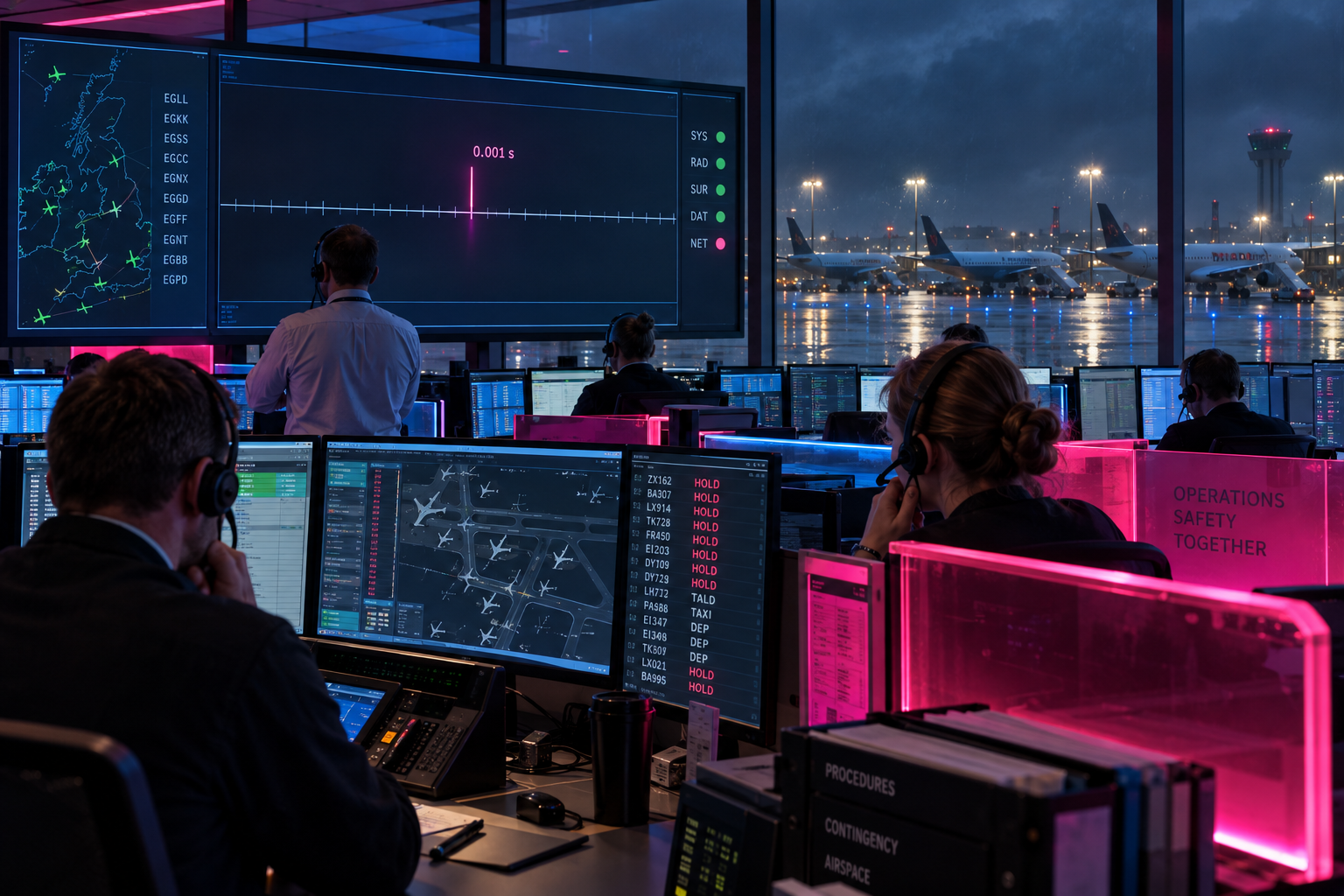
LONDON—Britain’s air traffic system has discovered the most expensive millisecond in computing history, a microscopic interval that managed to inconvenience hundreds of thousands of people before most humans had completed the blink required to read the delay notification.
The real incident began on September 8 when a controller made a valid manual request for an aircraft “squawk” code. According to a preliminary investigation by NATS, the company that manages much of the United Kingdom’s air traffic, a higher-priority system task arrived during an exposure window of roughly one millisecond. The first request paused. When it resumed, legacy software corrupted the output and some live flight data disappeared from the London Area Control operation.
For comparison, a millisecond is approximately how long it takes an airline website to decide the fare you saw has expired.
Controllers moved to manual procedures while engineers restarted and reloaded systems. Nationwide traffic restrictions remained in place for about six hours, operations returned to normal that evening, and the backlog took more than two days to clear. Major reporting counted more than 2,000 flights delayed, cancelled or diverted.
The nation enters airplane mode
Officials found no evidence of a malicious act or operator error. The problem was a race condition in old code: two legitimate processes reached for the same digital door handle at exactly the wrong moment, and the door responded by cancelling a continent.
Pink Slime’s fictional Department of Brief but Costly Events immediately designated the millisecond a “strategically significant unit of time” and offered it a corner office. It will supervise the nanosecond that deletes your unsaved document and the three seconds during which every self-checkout machine announces “unexpected item.”
“This employee achieved nationwide impact almost instantly,” said an imaginary transportation consultant, pointing to a performance chart that was mostly vertical. “Everyone says they want to move fast and break things. The software finally did both with measurable passenger volume.”
NATS said it has put a mitigation in place and is testing a permanent software fix. The company also noted that it has invested more than £1 billion in technology over the past decade and plans another £1 billion by 2033. This suggests the permanent repair may involve surrounding the offending millisecond with several hundred million pounds until it feels too self-conscious to act again.
Compensation arrives on a different timeline
The UK Civil Aviation Authority said passengers retain rights to rerouting or refunds and, in many cases, food, drink and accommodation while they wait. But because the disruption was caused by an air traffic control failure outside airlines’ control, fixed cash compensation for delay or cancellation is unlikely to apply.
In other words, the system may owe you dinner but not closure.
Airports responded as airports do: with departure boards glowing red, families sleeping near charging outlets and announcements asking everyone to remain patient in a building engineered to sell a bottle of water for the market value of a studio apartment.
Passengers were encouraged to contact their airlines, which encouraged them to use apps, which encouraged them to try again later. Several travellers reported achieving elite status in the circular-support program before ever leaving the terminal.
Legacy code requests a dignified retirement
The episode is a useful reminder that modern infrastructure is often a stack of new interfaces resting on old software that has been working perfectly since everyone stopped asking how it works. Aviation is extraordinarily safe because failures trigger conservative restrictions, manual fallbacks and layers of investigation. Unfortunately, “safe” and “on time” are cousins who exchange Christmas cards but rarely travel together.
NATS described the triggering request as valid and said the defect existed in legacy software. That matters: no controller typed the wrong command, no hacker seized the system and no passenger’s Bluetooth headphones brought down British aviation. A routine action simply arrived at the one instant when the code could mis-handle it.
The permanent fix will now proceed through testing, review and controlled deployment—an appropriately slow process designed to prevent another extremely fast one.
Meanwhile, the newly promoted millisecond has declined media interviews, citing a schedule conflict. It is reportedly booked solid until 2033, when it will return as a mandatory software update that cannot be installed because the aircraft is currently in use.