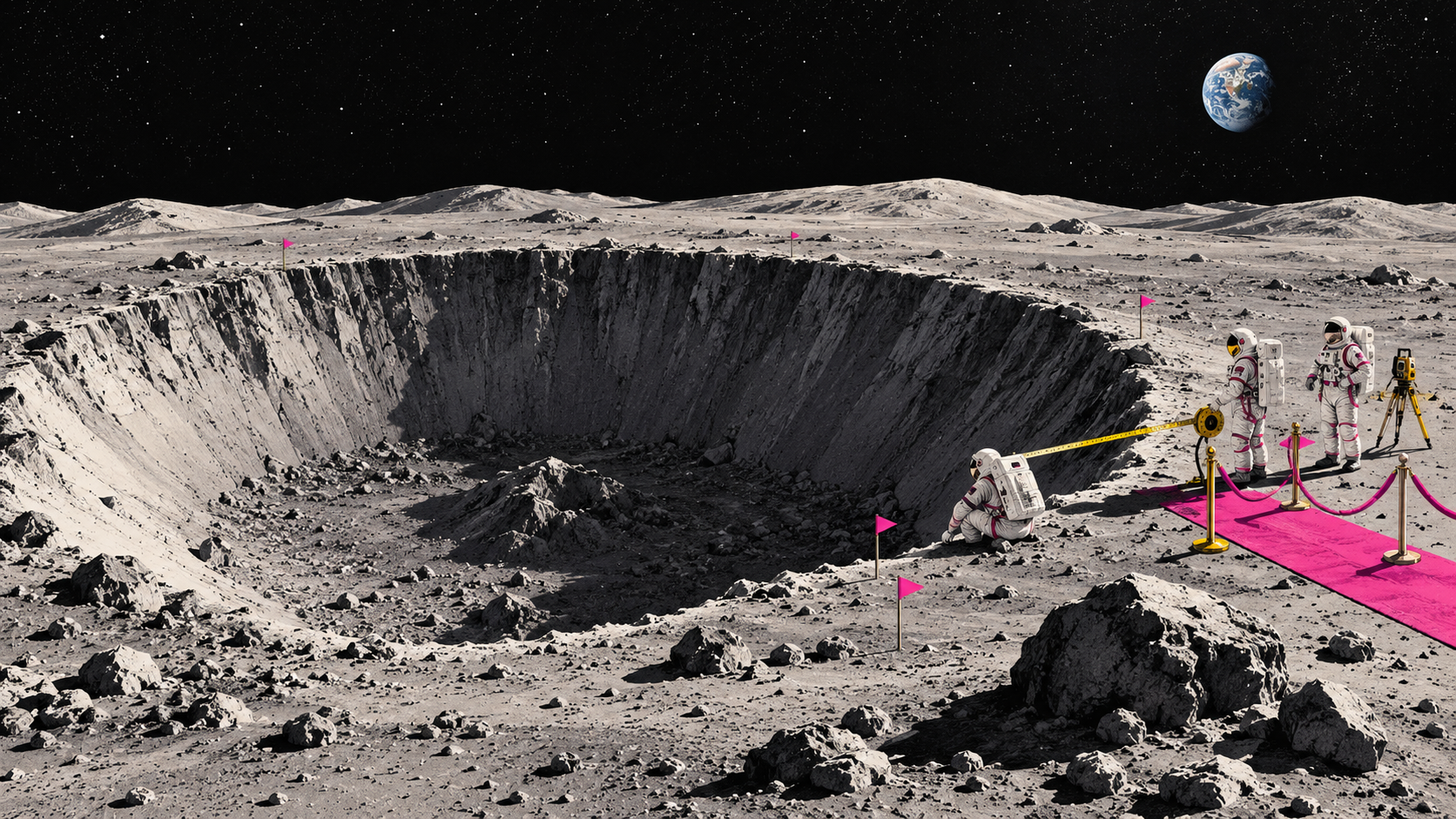
THE MOON—NASA scientists announced Wednesday that a chunk of asteroid or comet the size of a three- to six-story building slammed into the Moon in 2024, excavating a crater 728 feet wide and up to 141 feet deep. Lunar real-estate professionals immediately described the property as “an intimate fixer-upper with commanding views of permanent vacuum.”
The crater, officially named McGetchin for the late lunar scientist Tom McGetchin, is wider than two football fields and deep enough to stack three yellow school buses vertically. That comparison is useful because the Moon currently has neither football nor school districts, leaving NASA no choice but to measure catastrophe in the two units Americans still recognize.
Scientists estimate an impact this large happens about once every 132 years. The object struck between April 11 and May 22, 2024, yet nobody noticed in real time. It was discovered in August 2025 when an image specialist reviewing Lunar Reconnaissance Orbiter data compared before-and-after pictures and found that the Moon had quietly acquired a hole bigger than the Roman Colosseum.
The Moon has declined to explain why it waited more than a year to disclose the renovation.
Freshly gardened regolith, motivated seller
NASA says the impact churned lunar soil and debris across more than 66 miles. A separate study found a four-mile-wide cold spot surrounding the crater, where loosened soil cools more efficiently at night. Researcher David Paige compared the process to gardening, finally giving homeowners permission to describe a 141-foot-deep impact wound as “light landscaping.”
A fictional lunar listing prepared by Pink Slime News highlights the site’s “generous setback from oxygen,” “low-traffic neighborhood” and “newly aerated regolith.” The cold spot is marketed as a natural climate-control feature, although prospective buyers are advised that the local climate remains “space.”
The listing also boasts no property taxes, no plumbing and a commute that begins at roughly $100 million. There is no homeowners association, because the nearest homeowner is 238,855 miles away and still furious about recycling bins.
McGetchin is three times larger than the previous record-holder found by the orbiter. It is the biggest known impact crater formed anywhere in the solar system in recent times, which in property language means “largest new construction in a rapidly appreciating orbital market.”
Future base now includes complimentary helmet dents
The scientific stakes are less whimsical. NASA wants a sustained human presence on the Moon, and a surprise collision capable of throwing material across 100 kilometers is the sort of amenity astronauts prefer to learn about before move-in. Researchers plan to calculate the risk that ejected rocks could strike a future lunar base, helping engineers decide how much armor a building needs when the neighborhood occasionally shoots gravel at orbital speed.
The discovery also revises assumptions about how quickly the lunar surface changes. LRO has identified at least 1,000 new craters since 2009, and researchers now estimate that ejecta overturns the Moon’s top inch of soil every 80,000 years. The Apollo astronauts’ footprints, often described as nearly eternal because the Moon has no weather, will eventually disappear.
This news devastated the lunar preservation community, which had already printed brochures advertising “one careful owner, original 1969 flooring.”
NASA’s orbiter has been circling the Moon for more than 17 years, mapping its shape, composition, temperatures and radiation. Its long record allowed scientists to spot the new crater by comparing images across time—the planetary-science equivalent of realizing your upstairs neighbor removed a load-bearing wall after checking an old Zillow photo.
The impact itself escaped every telescope watching from Earth and space. A building-sized object traveled all the way to the Moon, hit hard enough to rearrange 66 miles of landscape and still avoided appearing in anyone’s notifications. It remains the most successful quiet renovation since a suburban dad finished a deck without obtaining a permit.
Insurance experts have not announced a lunar policy, but Pink Slime analysts expect the standard package to exclude impacts, vacuum, radiation, dust, darkness and anything else likely to happen on the Moon. Comprehensive coverage will remain available for accidental coffee spills inside the pressurized habitat, subject to a deductible equal to one small launch vehicle.
Future lunar settlers are therefore advised to budget for reinforced walls, meteorite insurance and a welcome mat that can survive violent soil redistribution. The Moon remains a beautiful place to build, provided buyers accept that the local market occasionally corrects itself with a rock the size of an office building.