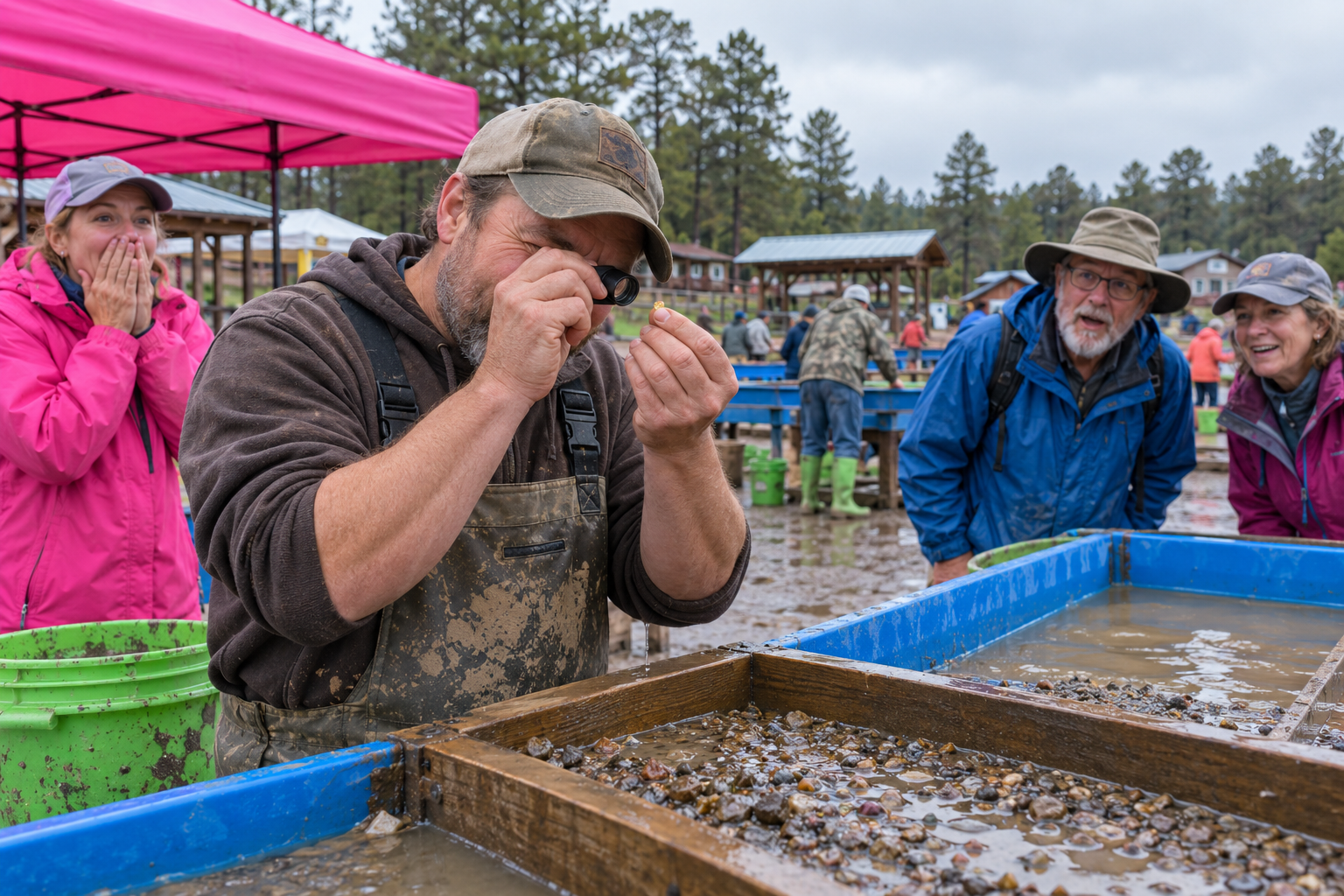
MURFREESBORO, Ark.—After more than 13 years of searching, a gem hunter has pulled a 6.03-carat yellow diamond from Arkansas dirt, proving that “keep digging” is inspirational advice exactly once every several million buckets.
Jack Pearadin and fellow hunter Michael Schumacher found the stone using gravel collected at Crater of Diamonds State Park. Pearadin was livestreaming the sorting process when the gem appeared. Arkansas State Parks later confirmed it as the fourth-largest yellow diamond and 22nd-largest diamond of any color registered since the site became a state park in 1972.
They named it the Pearadin Schumacher American Dream Diamond, because “Extremely Delayed Scratch-Off Ticket” lacked romance.
Dirt finally beats the market
The Associated Press reported Friday that collectors suggested the stone could be worth as much as $1 million. An experienced appraiser offered a more conservative estimate near $250,000, demonstrating that even a diamond can lose three-quarters of its value by asking a second adult.
Pearadin has found more than 300 diamonds since taking up the hobby in 2013 and even moved closer to the park. The park charges visitors $15 to search its 37-acre field and lets them keep whatever gemstones they find.
It is one of the world’s few diamond-producing sites open to the public. More than 37,000 diamonds have been registered there since 1972, meaning Arkansas has spent half a century operating a treasure hunt with better disclosure than most investment platforms.
Financial planners immediately added “repeatedly wash Arkansas mud” to the high-risk portion of their retirement worksheets, just below cryptocurrency and just above answering a text from your cousin about an opportunity.
Park officials stressed that most recovered diamonds are far smaller and worth a few hundred dollars. Pink Slime economists calculated that this changes nothing, because Americans have never allowed probability to interfere with a good folding chair and a bucket.
The American Dream, now machine-washable
The yellow stone is roughly the size of a gumdrop. It emerged from frozen winter gravel after years of patience, practice and discovering hundreds of diamonds that apparently did not qualify as life-changing enough.
The fictional Arkansas Department of Retirement Gravel has already proposed a national savings program. Workers would divert 6% of each paycheck into a damp five-gallon bucket. Employers may match contributions with a shovel.
For now, the hunters have not announced a sale. The diamond must still be cut, graded and presented to buyers, each of whom will carefully explain why the miraculous object is worth less than the last person said.
Still, after 13 years of searching, Pearadin has something rarer than a six-carat stone: documented proof that one obsessive hobby eventually worked.