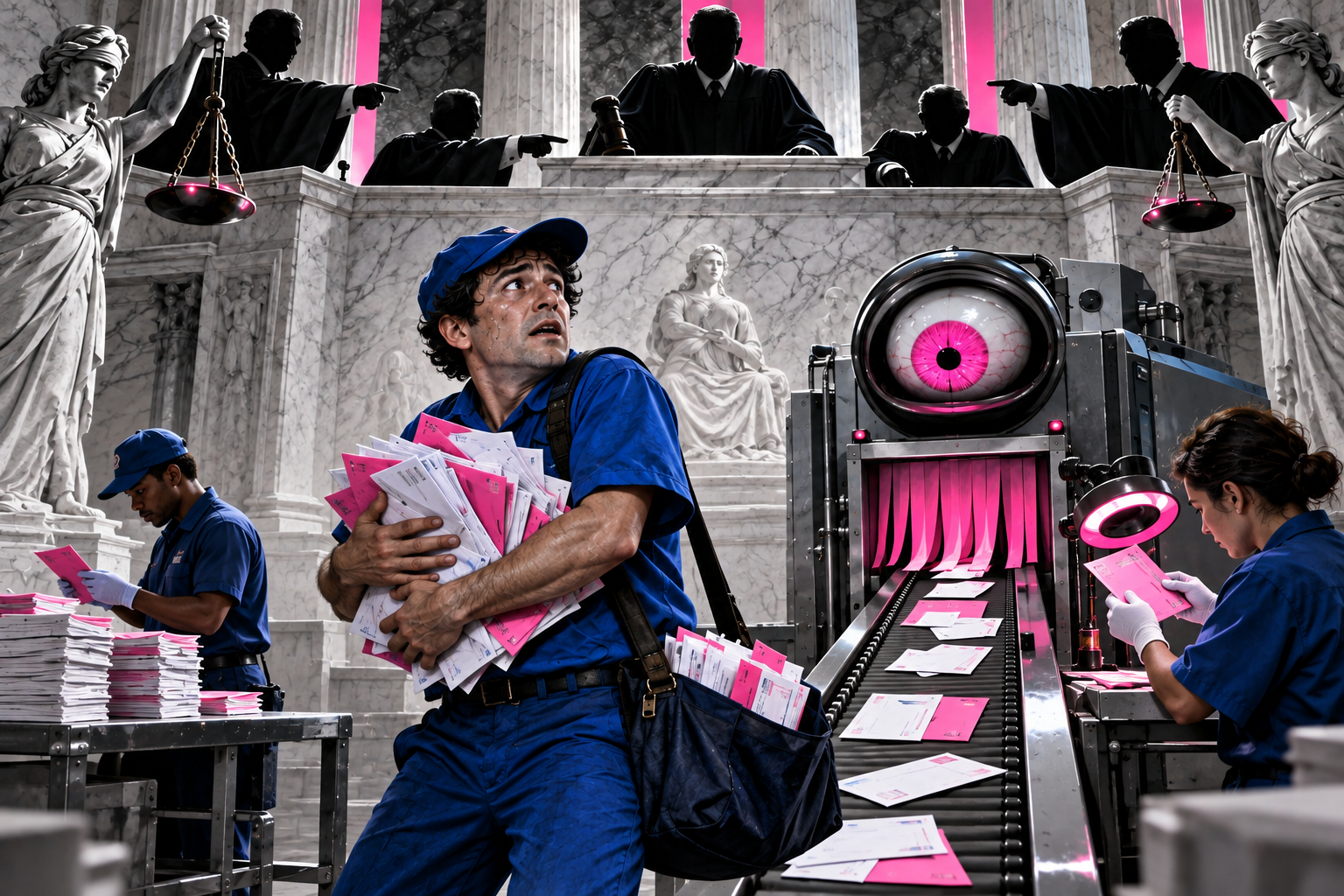
WASHINGTON—The Supreme Court declined to let the United States Postal Service begin a surprise second career as a ballot nightclub bouncer, allowing mail-voting systems to continue operating under the radical theory that mail carriers should carry mail.
The rejected proposal would have asked postal workers to distinguish legitimate ballots from suspicious envelopes using a sophisticated process known as “having absolutely no time for this.” Under the plan, the same people currently entrusted with birthday cards, utility bills and catalogs addressed to someone who moved in 2004 would have become the nation’s final line of electoral defense.
Postal employees learned about their potential promotion through the traditional federal method: television reporters discussing a plan nobody responsible for implementing it had been told about.
“I already have 760 houses, three apartment buildings and a dog named Lucifer on my route,” said one fictional carrier invented entirely for this parody. “If democracy needs me to verify voter eligibility between the Bed Bath & Beyond coupons and Mrs. Henderson’s arthritis medication, democracy needs to lower its expectations.”
Election security meets the junk drawer
The proposal imagined a streamlined process in which election officials would provide lists of eligible voters, postal workers would compare those lists against outgoing ballots, and the entire system would function flawlessly because government databases are famously identical, current and never maintained by a gentleman named Gary who retired without sharing the password.
Election administrators objected that voting was already underway and that inserting an improvised layer of postal verification could create confusion. Supporters countered that confusion is not a defect in American elections but one of the nation’s oldest renewable resources.
The Court’s decision preserves existing state procedures, meaning voters may continue navigating a calm, unified national system consisting of dozens of different deadlines, envelope rules, signature requirements and instructions printed in fonts normally reserved for pharmaceutical side effects.
Legal scholars described the ruling as narrow but consequential. Television scholars described it as “BREAKING” and placed it beside a pulsing red map for twelve consecutive hours.
A constitutional return-to-sender
The decision also spared the Postal Service from acquiring election-enforcement accessories, including tactical mail bags, body cameras for sorting machines and a specialized unit trained to interrogate suspicious absentee envelopes under a single flickering fluorescent bulb.
Inside the imaginary Postal Election Integrity Division, agents would have been authorized to ask hard questions: Who sealed you? Why are you traveling across state lines? And why do you smell faintly of a kitchen drawer?
For now, postal workers will return to their official duties: delivering the mail through heat, rain, snow and the relentless certainty that someone will ask whether they have “seen a package” without providing a tracking number.
Election officials, meanwhile, will resume counting ballots, defending their procedures and developing the facial expression of people explaining for the six-hundredth time that results taking time is evidence of counting—not evidence that a van full of fraudulent votes has arrived from Venezuela, Mars or a suburban Office Depot.
The nation is expected to accept the Court’s decision with its customary grace, patience and 94 million social-media posts written entirely in capital letters.