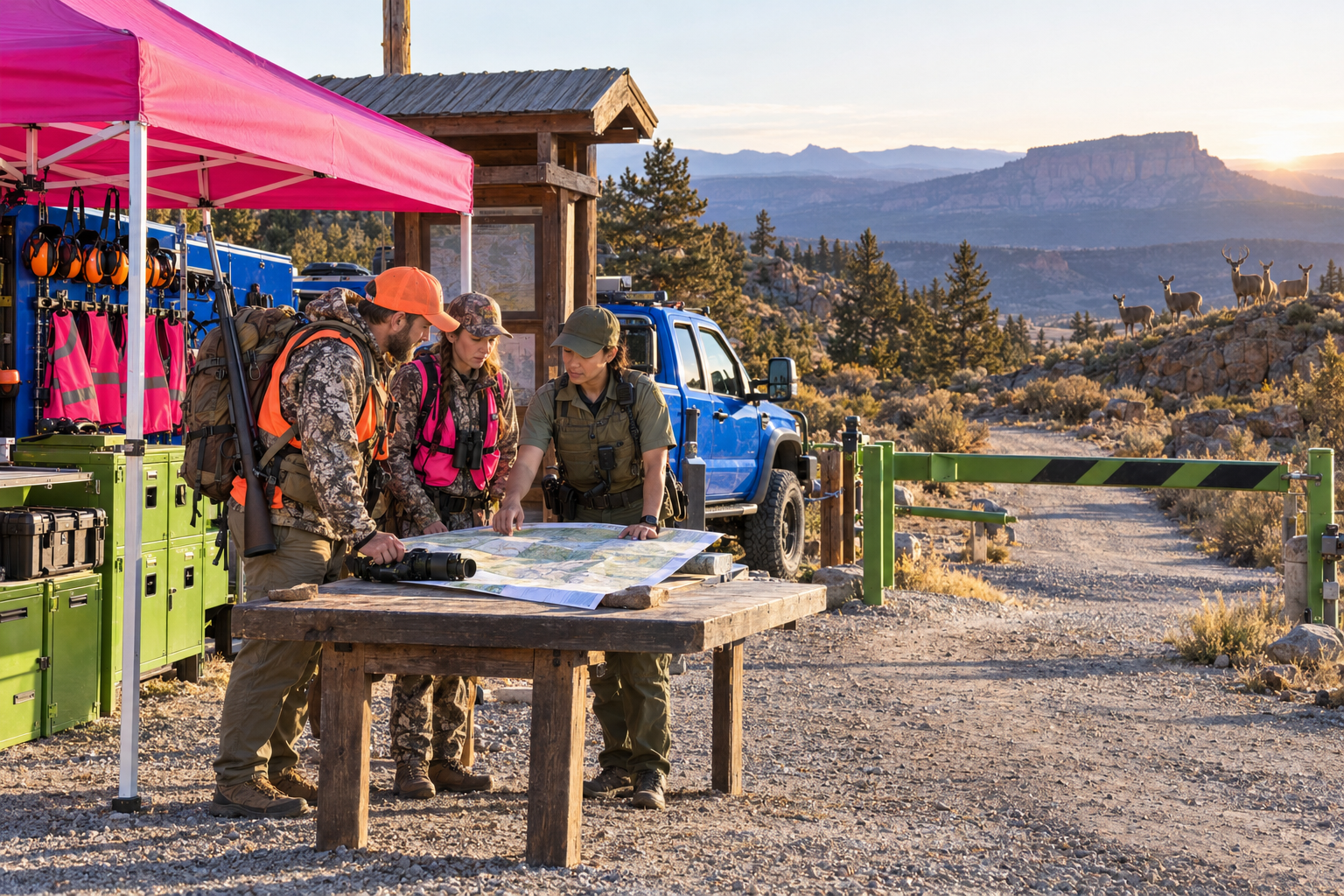
WASHINGTON—The federal government has informed America’s public lands that hunting is now the default setting, forcing millions of acres of forest, desert and scrubland to locate the tiny checkbox marked “No, I have a specific local-resource reason.”
Executive Order 14429, signed by President Donald Trump on September 17 and published in the Federal Register on September 22, directs federal land agencies to expand hunting, fishing, shooting and other recreational access. With exceptions for national parks and most national monuments, the order tells managers to generally allow hunting unless a closure can be justified by local conditions.
The practical effect will depend on agency rules, state wildlife law and future implementation. The emotional effect was immediate: every deer in the Mountain West looked up from breakfast and asked whether “presumption of accessibility” came with a calendar invitation.
Open by default, nervous by sunrise
The order specifically directs the Interior secretary, within 90 days, to allow hunting of species not protected under the Endangered Species Act at California’s Castle Mountains National Monument and Idaho’s Craters of the Moon National Monument and Preserve. It also orders a review of policies that restrict access across federally managed lands.
In a fictional emergency webinar convened by the National Association of Animals Standing Completely Still, wildlife was advised to update its privacy settings, disable location services and stop accepting friend requests from men whose profile pictures contain exactly one trout.
“Previously, federal access policy was confusing,” said an imaginary elk wearing a lanyard. “Now it is extremely clear that we should begin walking in less predictable patterns.” The elk then left through a door marked “Not a real quotation,” which remains the only closure no agency is required to justify.
The real order goes beyond opening gates. It calls for building, repairing and maintaining access infrastructure; pursuing voluntary easements and land exchanges; using qualified volunteers to manage wildlife and invasive species; authorizing assistive technology on trails and hunting locations; and permitting traditional lead ammunition and tackle.
It also sets deadlines for archery and hunter-education guidance in schools, more outdoor opportunities for young people and veterans, improvements to migratory bird hunting administration, and encouragement of expanded Sunday hunting. Washington has thus discovered the one government initiative capable of producing a calendar with both a 90-day review and a season for ducks.
Conservation enters the group chat
Hunting and fishing organizations broadly praised the order’s focus on access and conservation. Their argument is not invented: licenses, excise taxes and volunteer work provide major support for state wildlife agencies and habitat programs, and hunting is a tool used to manage some populations.
Independent reporting by Mountain West News Bureau also noted caution from conservation advocates. Backcountry Hunters and Anglers welcomed provisions on access and the two monuments but warned that separate proposals involving roadless areas and off-road vehicle rules could trade durable habitat for short-term access. The National Wildlife Federation similarly said the results would depend on implementation.
This is the familiar public-lands paradox: everyone wants access, everyone wants healthy habitat, and everyone defines “reasonable road” as the road that stops immediately after their own truck arrives.
The order’s endorsement of lead ammunition and tackle adds another live dispute. Supporters value availability and performance; critics point to lead exposure in wildlife and ecosystems. Pink Slime’s imaginary Office of Simple Answers reviewed the issue and dissolved after discovering it contained science, economics, tradition, regulation and at least three kinds of bird.
The wilderness receives new operating hours
For federal managers, the next several months will be less cinematic. Agencies must review existing restrictions, write guidance, coordinate with states, propose regulations and explain which closures remain necessary. This process will occur mostly in memos, proving once again that even the American frontier can be defeated by tracked changes.
For hunters, the order promises easier access and a stronger role in land stewardship. For conservationists, it raises questions about roads, habitat and how broadly the presumption will be applied. For wildlife, no official comment was available because the press office had migrated.
By dawn, fictional trailhead kiosks nationwide had installed three lanes: hunting access, fishing access and animals attempting to appeal a local-resource determination. The animals were asked to take a number. The number was 90 days.