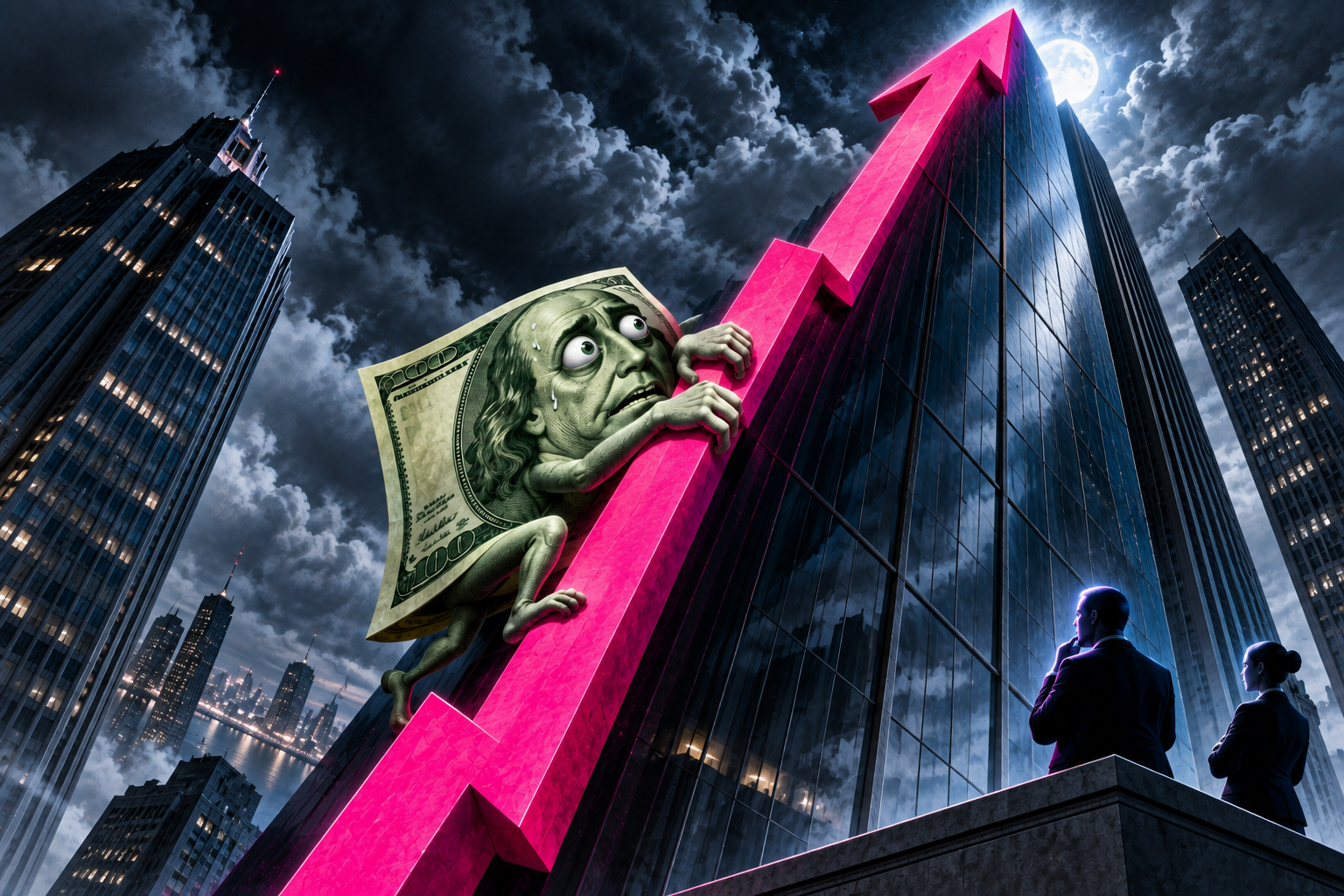
WASHINGTON—The Federal Reserve is reportedly considering another interest-rate increase, continuing its long-running effort to cool inflation by making everyone stare at a mortgage calculator until they lose interest in owning things.
Officials said the possible increase would send a firm message to rising prices: please stop, or the central bank will make borrowing money even more emotionally expensive.
The strategy rests on a central principle of modern economics: if groceries, housing and energy become unaffordable, the solution is to make cars and houses more unaffordable until everybody becomes too discouraged to participate.
“We are watching the data,” said a fictional economist looking into the middle distance. Asked what the data was doing, he replied, “Mostly watching us back.”
Markets bravely panic
Financial markets responded to the news with their traditional mixture of confidence, terror and men wearing fleece vests saying “priced in” to one another. Stocks moved upward, downward and occasionally sideways as investors processed the possibility that the cost of money—already a concept designed to make normal people tired—might soon cost more money.
On Wall Street, analysts examined charts containing at least seven colors, nine arrows and one line that appeared to be fleeing the building. A senior strategist explained that the market could rally if rates rise, fall if rates rise, or remain flat if rates rise in exactly the manner everyone expected but somehow had not anticipated.
Consumers were advised to remain calm and postpone major purchases until the economy finishes doing whatever this is. Families hoping to buy a home were encouraged to consider more affordable alternatives, such as purchasing a decorative pillow with a house printed on it.
Prospective car buyers, meanwhile, can still obtain financing through new 144-month loans that allow customers to complete their final payment shortly after the vehicle qualifies for historic preservation.
Inflation summoned to a meeting
Federal Reserve officials hope higher borrowing costs will slow demand and eventually persuade inflation to return to its assigned seat. Inflation has thus far ignored several emails, declined the calendar invitation and marked the entire central bank as spam.
Economists cautioned that some current price pressures come from forces interest rates cannot easily control. The Fed cannot manufacture oil, build apartments overnight or politely ask a geopolitical crisis to circle back in Q4. It can, however, make your home-equity line of credit feel like a personal betrayal.
At grocery stores, shoppers reported that prices remain highly visible. A carton of eggs now comes with a sommelier, a security escort and a brief presentation on its provenance. Olive oil is stored behind glass. A family-sized bag of chips contains enough nitrogen to operate a small laboratory and seven chips arranged ceremonially at the bottom.
The public remains divided over the proper response. Some want rates cut to support growth. Others want them raised to contain prices. A third group would like someone to explain why a sandwich, two drinks and a tip now require financing.
The Federal Reserve declined to promise what comes next, preserving its important institutional tradition of using 4,000 carefully selected words to communicate the emotional atmosphere of “maybe.”