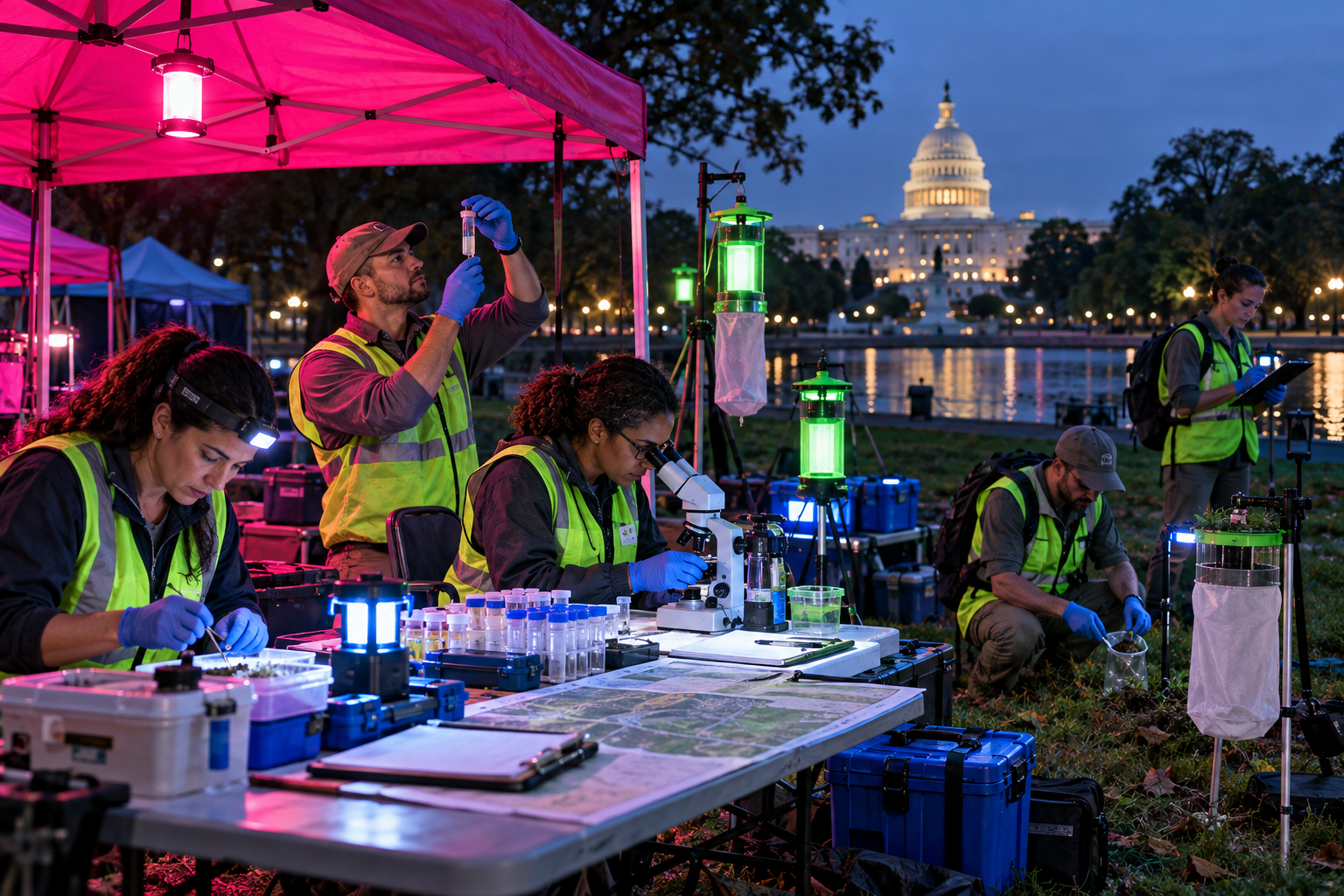
WASHINGTON—President Donald Trump signed an executive order Tuesday directing the federal government to reduce invasive mosquito populations in the capital by 90 percent and tick populations by 50 percent by 2028, launching the first major Washington campaign in years whose intended targets are actually supposed to suck blood.
The order gives the Interior Department, Agriculture Department, Environmental Protection Agency and General Services Administration 60 days to develop and begin carrying out a District-wide pest campaign in consultation with the Department of Health and Human Services. This means the nation’s smallest enemy will be confronted by at least five agencies, which is the bureaucratic equivalent of calling in an aircraft carrier because something buzzed near the potato salad.
The plan may include improved drainage, different landscaping, targeted mowing, rain gardens, natural predators and commercial pest-control capabilities. It also calls for a framework to evaluate advanced technologies such as sterilization, beneficial bacteria and “safe genetic modification,” ensuring every male mosquito in Washington now understands that a mysterious calendar invitation from EPA Human Resources should not be accepted.
A measurable war at last
Unlike wars on drugs, poverty, inflation or the phrase “per my previous email,” this campaign comes with numeric goals. Ninety percent of certain mosquitoes must go. Half the ticks must also pack up, although officials have not explained whether the remaining half will be allowed to stay on a performance-improvement plan.
Under Pink Slime’s entirely fictional implementation memo, each insect will receive a tiny federal exit interview. Mosquitoes may select “better opportunity elsewhere,” “lack of stagnant water” or “romantic sterilization incident.” Ticks refusing to leave will be reassigned to a deer outside the Beltway and told the commute is now part of the hybrid-work policy.
The administration’s factual case is serious. Mosquitoes can spread West Nile virus, dengue, Zika and chikungunya. Ticks transmit Lyme disease and can trigger alpha-gal syndrome, an allergy to mammalian meat and related products. The order tells HHS and the Food and Drug Administration to explore warnings for foods and medicines containing alpha-galactose, because apparently a bite no bigger than a punctuation mark can turn a cheeseburger into a medical questionnaire.
Operation Please Stop Biting Us
Federal planners are now expected to assemble an interagency task force with the confidence of a Pentagon briefing and the equipment of a very aggressive garden center. Maps will be unrolled. Drainage ditches will be circled. Someone will point at a photograph of a birdbath and whisper, “There’s our guy.”
The real order also calls for prize competitions and research programs to improve testing, prevention and treatment of mosquito- and tick-borne disease. Agriculture officials are directed to seek non-chemical control methods. In the fictional version, the grand prize is a federal contract and the second prize is permission to spend a July evening outside without donating three tablespoons of ankle to science.
Beneficial bacteria and sterile-insect techniques are not science fiction. Programs using Wolbachia bacteria and non-biting sterile male mosquitoes have already been deployed in the Washington region to suppress populations of Asian tiger mosquitoes. The strategy works by making mosquito reproduction dramatically less productive, finally forcing nature to experience what humans call a dating app.
Still, a 90 percent target invites difficult questions. Will the reduction be measured by traps, bites, angry cookout surveys or the number of residents slapping themselves on Metro platforms? What happens if a mosquito crosses the Maryland line, feeds in the District and deducts its travel expenses in Virginia? Is a tick on a federal employee considered a contractor?
The swamp fights back
Washington’s mosquitoes declined to comment, citing an ongoing mating season. A fictional spokesperson for Local 1 of the United Invertebrates said the order “attacks good, bloodsucking jobs” while ignoring the capital’s much larger population of organisms that survive by attaching themselves to people with money.
The executive order does not promise nationwide eradication, nor does it suggest every insect is dangerous. It focuses first on the District and invasive species while directing agencies to build research and policy that could be used more broadly. The distinction matters: this is a public-health program, not a tiny vengeance parade with helicopters.
By 2028, Washington may have fewer mosquitoes, fewer ticks and substantially more acronyms. Residents could enjoy parks without marinating themselves in repellent. Federal scientists could develop better diagnostics and prevention. And the government may finally prove it can coordinate across departments when the opposing lobbyists are six millimeters tall and too busy looking for exposed calves to schedule a fundraiser.
Until then, the mosquitoes remain at large, heavily armed with proboscises and absolutely unmoved by the 60-day deadline. They have survived dinosaurs, ice ages and every picnic in human history. But they have never faced the full force of a federal working group with a color-coded spreadsheet.