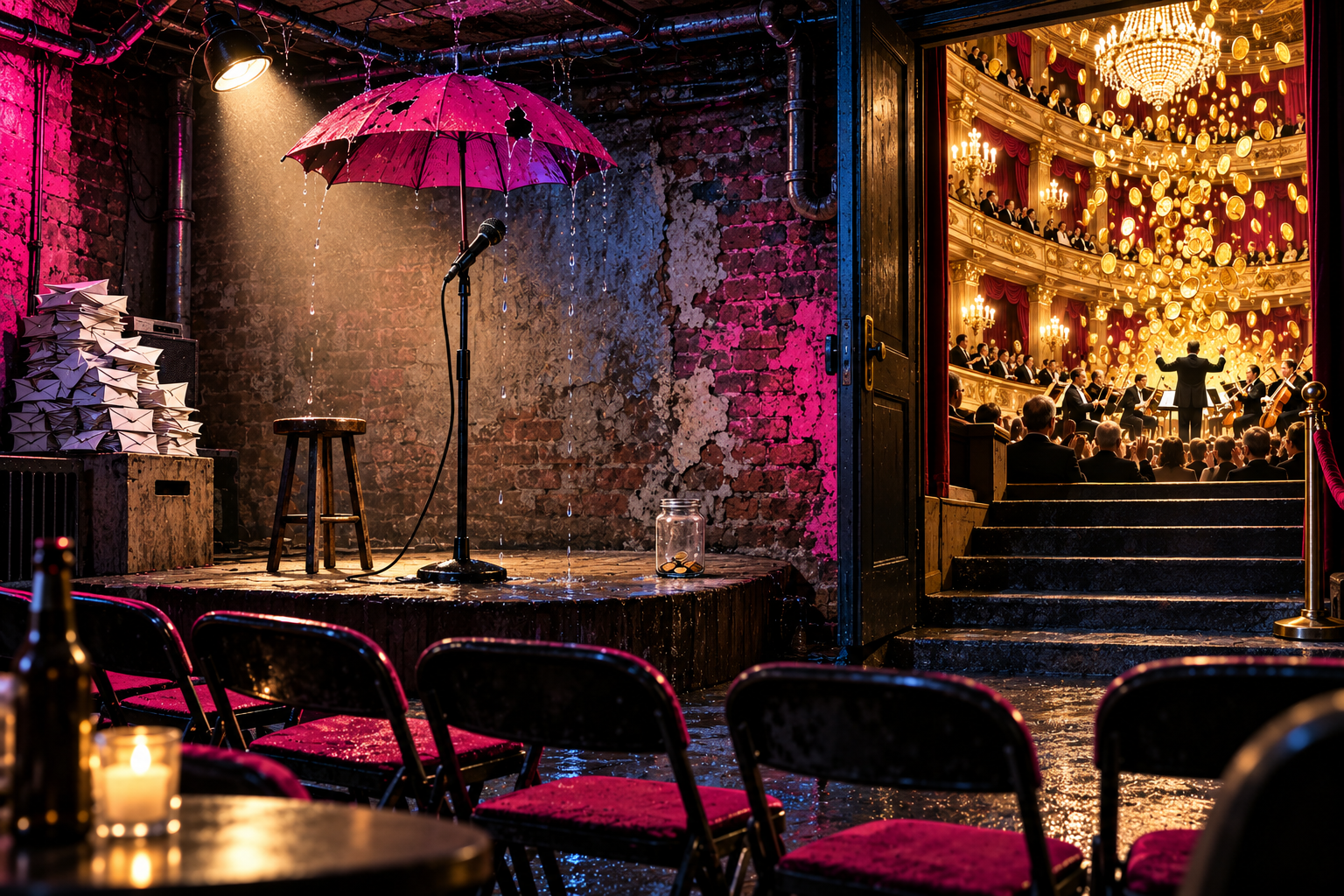
LONDON—More than 90 comedy professionals have asked Britain to recognize comedy as an actual art form, forcing government officials to confront the possibility that the nation’s most famous cultural export may require more support than a brick wall, a warm lager and one optimistic person holding a clipboard.
The warning followed a brutal week in which Leicester Comedy Festival collapsed, the Underbelly Boulevard Soho venue announced it would cease trading, and the BBC canceled Live at the Apollo. Organizers described the sector as being in crisis. Whitehall’s fictional Department for Things That Count Only After They Vanish immediately opened a consultation on whether three closures constitute a trend or merely a very committed setup.
“Comedy is clearly important,” said an entirely invented deputy minister while sliding a microphone into the government’s Lost Property drawer. “Unfortunately, the funding application asks applicants to select music, theatre, dance or miscellaneous emotional noise. There is no box marked ‘person sweating beneath a spotlight while explaining divorce to 14 strangers.’”
A national treasure with a tip jar
The open letter, organized by the Comedy Representation and Artform Trust, argues that comedy is everywhere in British culture but largely absent from British policy. Its signatories include prominent performers and industry figures. The group says comedy has received less than £15 million in public investment over 25 years and is asking for dedicated funding, tax relief, VAT reform and business-rates support.
That sounds like a lot of money until you divide it by a quarter century, at which point it becomes roughly enough to replace the batteries in Britain’s emergency heckler alarm.
The Live Comedy Association has separately called for grassroots comedy to be recognized alongside grassroots music in cultural policy. Earlier this month it said more than 60 members of Parliament supported that goal, including over 45 who signed a joint letter to the culture secretary. The requests include research into the sector’s economic contribution, support for freelancers and venues, and consideration of a levy on large comedy events to help the grassroots circuit.
The real proposals are strikingly conventional. They ask the government to study an industry, recognize its business model and stop taxing a basement gig as though every folding chair is a luxury yacht. This has left policymakers dangerously exposed to the suspicion that comedians may be the adults in the room.
The Arts Council discovers genre
Campaigners say comedy is frequently treated as a “genre” rather than a distinct art form, requiring applicants to squeeze projects into categories designed for theatre or combined arts. Pink Slime’s fictional Cultural Classification Unit demonstrated the distinction with a flowchart. If a performer cries beneath dramatic lighting, it is theatre. If the audience cries too, it is important theatre. If the audience laughs, everyone is sent to the pub and instructed to build a sustainable ecosystem without touching public money.
The system has created a fascinating national policy: Britain may export comedians, television formats and panel shows around the world, but the rooms where those performers learn their craft should apparently survive on exposure, crisps and the economic multiplier produced by six people splitting a taxi.
Leicester Comedy Festival alone was worth up to £10 million a year to its local economy, according to current reporting, before collapsing with debts exceeding £200,000. Hundreds of performers and businesses had already faced delayed ticket-income payments earlier this year, prompting the Live Comedy Association to establish an emergency £5,000 hardship fund.
Officials praised the fund as a model of community resilience, then stood very still in the hope nobody would compare £5,000 with the phrase “national cultural infrastructure.”
Please submit evidence that jokes exist
Under a draft program imagined by Pink Slime, comedians seeking recognition would be required to submit three years of audited laughs, demographic evidence for every chuckle and a risk assessment covering the possibility that the front row is on a first date. Successful applicants would receive a commemorative lanyard and permission to describe themselves as “arts-adjacent.”
The application would also ask whether the project contains dance. Comedians are advised to tick yes if they have ever moved a microphone stand six inches while telling a story.
Behind the absurdity is a familiar cultural problem. Grassroots rooms develop talent long before television networks, arenas and streaming platforms monetize it. When those rooms disappear, the polished end of the industry does not immediately collapse; it simply continues consuming a pipeline nobody is maintaining, like a restaurant confidently serving the last potato.
Campaigners are asking the government to act before more venues, festivals and freelancers vanish. The Department for Things That Count Only After They Vanish said it would respond as soon as the crisis had completed the necessary paperwork proving it was preventable.
In the meantime, Britain’s comedians will continue performing the nation’s most reliable public service: standing in underfunded rooms and explaining, with excellent timing, exactly what everyone else has done wrong.