WASHINGTON—President Donald Trump on Monday disputed his own ambassador’s account that he had asked Chinese President Xi Jinping whether China wanted to buy American weapons, then reportedly left the conceptual cash register open by saying the idea might be good.
The confusion began after U.S. Ambassador to China David Perdue told Fox News that Trump had, at some unspecified point, asked Xi if he would like to buy American arms. Perdue offered the anecdote while discussing U.S. weapons sales to Taiwan, apparently deciding that the fastest way to clarify one of the world’s most delicate security arrangements was to introduce a second, legally impossible checkout lane.
When reporters asked Trump about the comment, he said he had not heard of it and suggested Perdue probably meant Taiwan. That explanation briefly restored the familiar geopolitical map before Trump added that selling weapons to China might be a good idea, causing every export-control lawyer in Washington to make the same sound a smoke detector makes when the battery is dying.
Welcome to Defense Depot
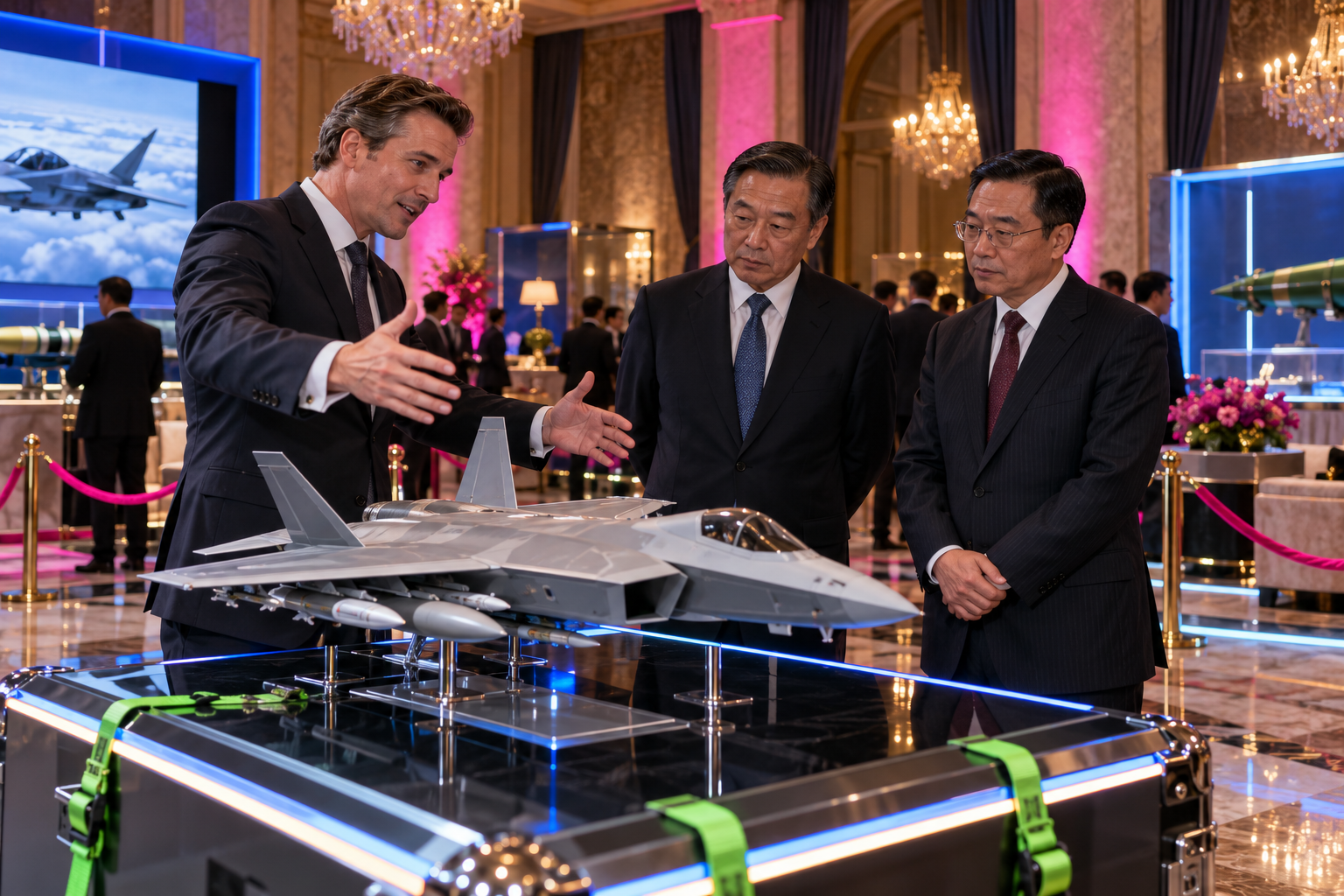
Under Pink Slime’s entirely fictional account, the White House has now opened a diplomatic showroom called Defense Depot, where visiting leaders may browse fighter jets beneath flattering track lighting while a sales associate asks whether they are shopping for deterrence, regional instability or something nice for the weekend.
“This model comes with stealth coating, heated seats and a free canvas tote if you join our rewards program,” an imaginary representative explained while tapping the wing of a display jet. “If you purchase the aircraft carrier today, we can waive delivery on the first three proxy conflicts.”
The actual State Department says U.S. arms transfers are assessed for their political, military, economic, arms-control and human-rights consequences. Major sales also require congressional notification and review. This is the government’s formal way of saying the missile cannot simply be added to a guest’s room bill.
Sales to China are prohibited under longstanding U.S. restrictions. The United States instead sells defensive weapons to Taiwan, which Beijing claims as its territory and has threatened to take by force if necessary. A proposed package for Taiwan worth roughly $14 billion has been under discussion, placing the ambassador’s anecdote somewhere between an extraordinary policy revelation and the most expensive case of pointing at the wrong customer.
Would you like protection with that?
The contradiction also creates a new diplomatic doctrine: strategic upselling. Under the old system, Washington armed partners to deter rivals. Under the new imagined system, rivals receive a courtesy follow-up email reading, “We noticed you were looking at our fifth-generation aircraft. Complete your purchase before Taiwan does.”
Congressional staffers have been assigned to develop the required financing menu. Options include zero percent interest for twelve months, trade-in credit for lightly used ballistic missiles and a buy-one-get-one arrangement in which the second regional security crisis is of equal or lesser value.
The Pentagon’s fictional customer service division is also drafting a return policy. Weapons may be returned within thirty days if unused, unopened and not deployed across a disputed maritime boundary. Hypersonic systems are final sale. Store credit cannot be redeemed during a sanctions emergency.
None of this resolves what Trump actually said to Xi. Perdue did not specify when the alleged question was asked, Trump denied the account, and U.S. officials said there was no offer or plan to sell arms to China. The facts therefore sit in the standard Washington configuration: one ambassador, one president, two incompatible stories and several thousand analysts explaining that the inconsistency itself is the policy.
The brochure remains classified
For Taiwan, the joke is considerably less funny. Its security depends on credible American support, timely weapons deliveries and the assumption that Washington can distinguish the intended recipient from the military power those weapons are supposed to deter.
The White House has not announced a China arms sale because there is no lawful program to announce. The State Department’s public list of recent foreign military sales includes allies and partners such as Denmark, Ukraine, Japan and Saudi Arabia—not China. There is no “surprise me” button for strategic competitors.
Pink Slime’s showroom will nevertheless remain open through the end of the state-visit season. Guests are asked not to touch the guidance systems, lean on the submarine or ask whether the extended warranty covers a congressional investigation.
At closing time, staff will place the fighter jets back in their velvet cases and reconcile the day’s receipts. The United States will continue selling weapons according to law and policy, China will continue objecting to sales to Taiwan, and Washington will continue discovering that “maybe it’s a good idea” is not the same thing as interagency review.