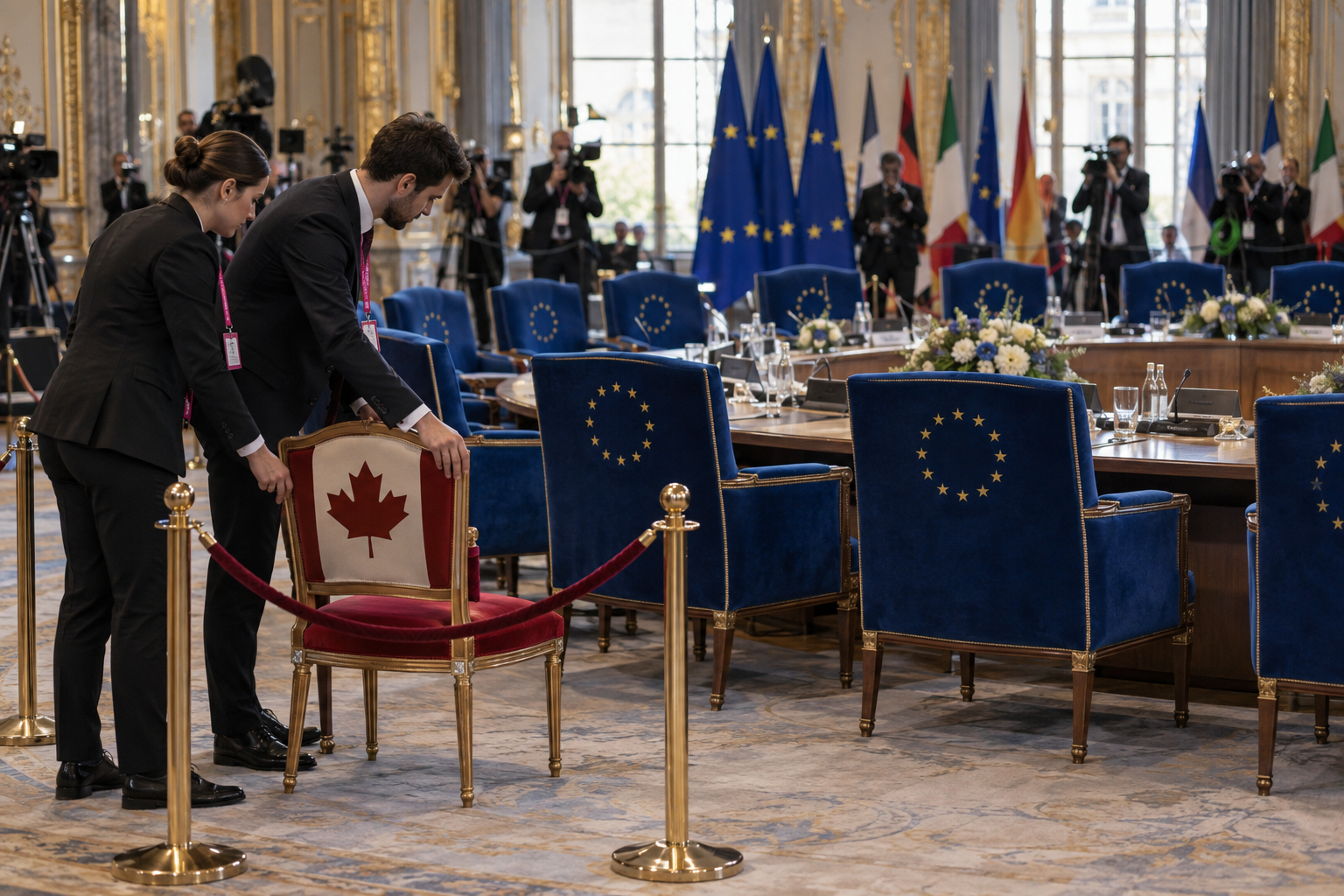
BRUSSELS—The European Union has offered Canada “associate membership,” an exciting new international status that does not currently exist, proving once again that the continent responsible for both the Enlightenment and the laminated restaurant menu remains fully capable of inventing the form before deciding what the form is for.
European Commission President Ursula von der Leyen proposed the arrangement during her State of the European Union address Wednesday, telling Canadian Prime Minister Mark Carney that she wanted to work on “opening the door for Canada being the first associate member of the EU.” Canada welcomed the gesture, while treaty lawyers quietly searched the building for the door.
The category is not defined in EU law. It is also different from the association agreements already used by more than 20 countries to govern trade, security and political cooperation. Those agreements exist, have rules and can be located by professionals using ordinary office equipment, which apparently made them insufficiently visionary for the occasion.
Membership benefits still loading
Under the entirely fictional introductory package imagined by Pink Slime, Canada would receive one ceremonial blue chair, limited access to the single market lounge and 30 gigabytes of roaming bureaucracy per month. Maple syrup could circulate freely, but only after its emotional connection to Vermont had been disclosed on Form 27-B.
The associate member would be entitled to attend European family photos while standing slightly beyond the velvet rope, close enough to smile but far enough away that nobody has to amend the caption. Voting rights, budget contributions, passport privileges and the precise meaning of “member” would be supplied in a later software update.
This is not to say the political idea is meaningless. Canada and the EU already share a major trade agreement, CETA, and the proposal comes as both sides seek deeper cooperation on defense, Arctic security, energy, critical minerals, technology and supply chains. Carney has emphasized that Canada is not seeking full EU membership. The point is a closer strategic relationship, not moving Quebec next to Portugal on the map.
Still, the label matters because European institutions have spent seven decades constructing a legal vocabulary in which every noun arrives with 900 pages of annexes. Introducing “associate member” without a definition is like launching a Scandinavian furniture kit containing only a photograph of the chair and a note that says the screws will be conceptual.
Twenty-seven approvals, one imaginary box
Any formal treaty or enlargement decision would require unanimous agreement from all 27 EU member states. According to the Associated Press, von der Leyen did not widely consult those governments before announcing the idea. Germany welcomed a discussion about new partnership models while expressing reservations about the title. Ireland said it was prepared to explore the concept. In other words, Europe has reached the important first stage of unity: several people agree that a meeting should be held about what they may eventually agree to call it.
Pink Slime’s fictional Directorate-General for Premature Categories has already begun drafting the application. Question one asks whether Canada is in Europe. Applicants may select “geographically,” “emotionally,” “during hockey season” or “please see attached strategic circumstances.”
Question two requests Canada’s preferred relationship status: single market, customs union, association agreement, associate membership, it’s complicated, or “we have both been receiving disturbing messages from the United States.”
The announcement arrives during a trade conflict between Canada and the United States. President Donald Trump has warned that closer EU-Canada ties could be treated as hostile and trigger tariffs. This gave the undefined proposal immediate geopolitical weight: nothing accelerates the creation of a European legal instrument like an American president threatening to tax it before it exists.
A relationship status for the modern age
There is a serious argument for flexible alliances among democracies that share economic and security interests but do not fit neatly inside existing institutions. The EU is surrounded by countries that want varying degrees of market access, political alignment and defense cooperation without identical paths to full membership. Canada, sitting an ocean away with a large economy and Arctic territory, makes the geography unusual but the strategic logic understandable.
The challenge is turning the applause line into a durable arrangement. Officials must define rights, obligations, governance and the relationship to existing treaties, then persuade every member government to approve it. Only after that can the new status achieve its final European form: a badge, a lanyard and an online portal that works in 23 languages except the one selected by the user.
For now, Canada has been invited into a club whose new membership tier is being built around the invitation. Protocol staff reportedly placed an extra chair near the EU table and attached a temporary sign reading “Strategically Adjacent.”
The chair has no vote, no legal basis and no confirmed position in the room. It does, however, come with excellent healthcare and a tremendous sense of possibility.