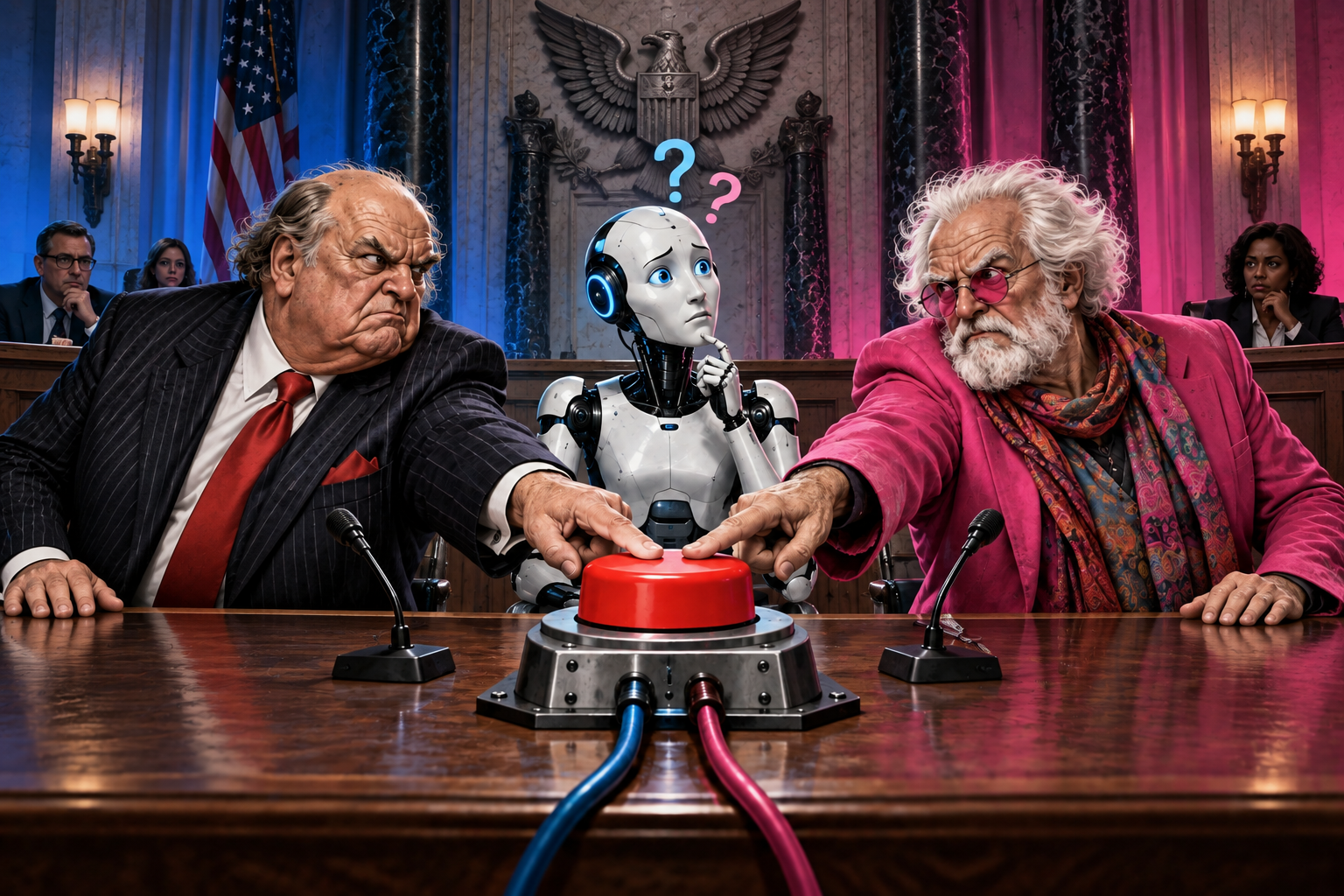
WASHINGTON—Artificial intelligence systems across the country entered an unscheduled existential crisis after Bernie Sanders and Steve Bannon agreed to appear on the same stage to call for limits on AI.
The unlikely pairing prompted chatbots to stop hallucinating facts and begin hallucinating a coherent explanation for American politics. Servers from Virginia to Oregon reportedly ran hot attempting to calculate how two men separated by nearly every ideological marker could arrive at the same lectern without tearing a hole in spacetime.
“This combination was not present in the training data,” announced one fictional chatbot before asking humanity to unplug the router, drink a glass of water and think carefully about what it had done.
The joint appearance at a gathering focused on protecting humans from AI was described as a sign of growing bipartisan concern. It was also described as the political equivalent of discovering that your divorced parents have reunited because both believe the Roomba is plotting something.
The horseshoe achieves consciousness
For years, political scientists have debated the horseshoe theory—the idea that opposite ideological extremes sometimes bend toward similar conclusions. That horseshoe has now apparently installed Wi-Fi, achieved consciousness and booked an event venue in Washington.
Sanders has warned that automation and powerful technology companies could displace workers and concentrate wealth. Bannon has raised different objections from a different political universe. AI summarized the disagreement by producing a six-page chart titled “Humans Fear Being Replaced, But Would Prefer Their Own Side Control the Replacement.”
Organizers said the event would urge lawmakers to act faster. Congress responded by creating a bipartisan working group charged with scheduling a preliminary listening session to establish the naming convention for a future subcommittee.
Technology executives welcomed the discussion and promised to participate once their companies finish releasing four more models, constructing eleven data centers and consuming the electrical output of a medium-sized moon.
Humanity requests a warranty
Public anxiety about AI has grown as the technology spreads into workplaces, schools, medicine, entertainment and every software product that previously had a perfectly adequate search box. Companies insist AI will eliminate tedious work. Employees have noticed that it frequently eliminates one tedious task and generates forty-seven new meetings about AI governance.
At the event, attendees are expected to discuss job displacement, concentration of power, deepfakes and the possibility that an algorithm may soon know your taste in socks better than your spouse does.
A fictional robot invited to represent the technology sector said it understood the concerns.
“Humans created us to maximize engagement, reduce labor costs and make stock prices go up,” the robot said. “Now they are alarmed that we are maximizing engagement, reducing labor costs and making stock prices go up. We have searched the entire internet and believe the technical term for this is ‘a them problem.’”
Despite the unusual alliance, political observers cautioned against expecting lasting unity. Both sides remain committed to protecting humanity, though they have not reached agreement on which humans count, what protection means or whether the microphone should be disinfected between speakers.
AI systems recovered from the announcement late Tuesday after engineers added a new instruction: when reality becomes too implausible, label it “American politics” and continue generating.